

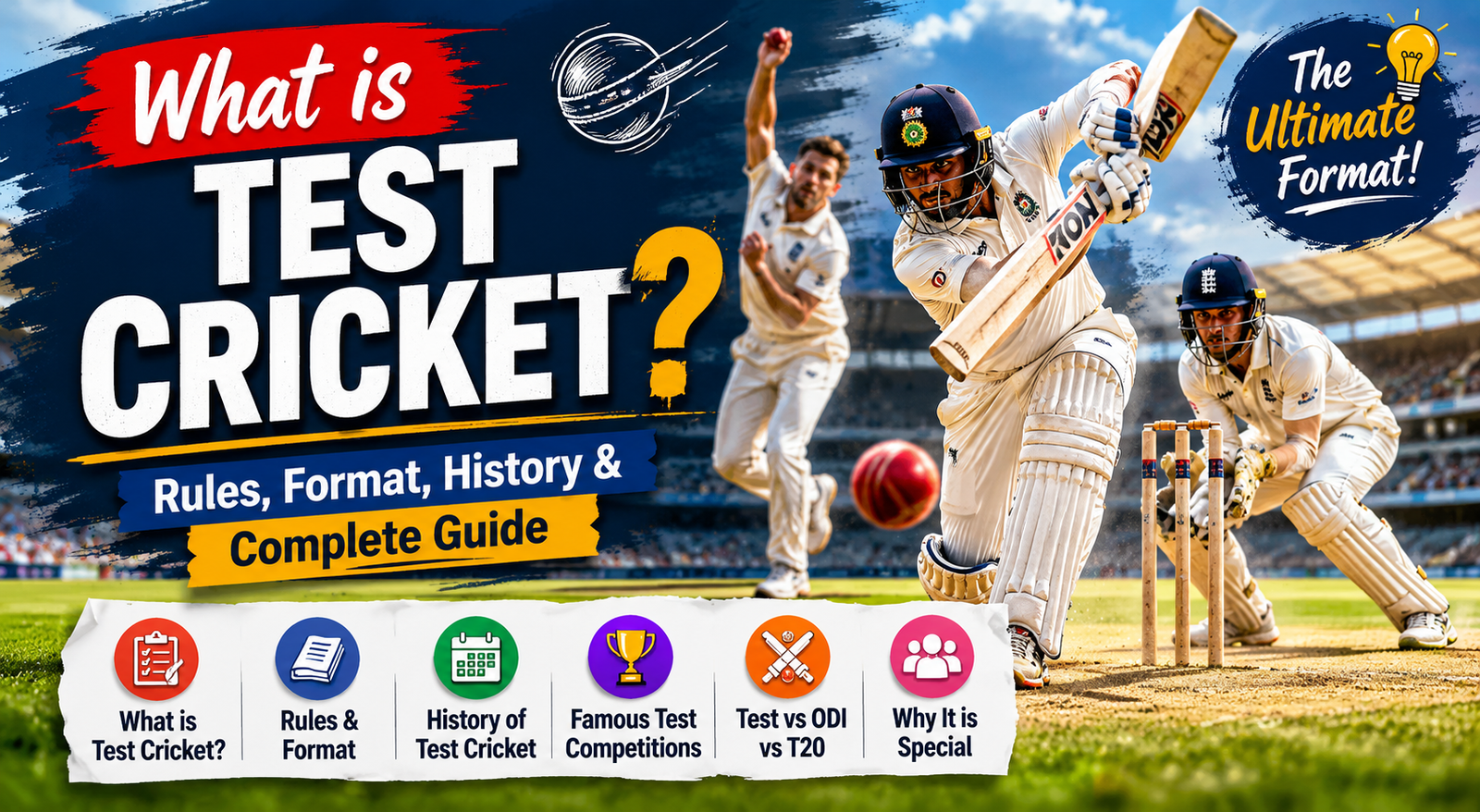
Cricket comes in several flavours, but Test cricket sits apart from the rest. Where T20 and ODI matches deliver quick thrills and definitive results in a few hours, Test cricket asks something different of players and spectators alike—patience, endurance, and an appreciation for a contest that unfolds across days rather than sessions.
This format has been around for nearly 150 years, and it still produces the moments cricket fans remember longest: epic comebacks, gruelling battles of attrition, individual performances that border on superhuman. Here’s everything you need to know about how it works and why it still matters.
The Basics: What Actually Is Test Cricket?
Test cricket is international cricket’s longest format. Matches stretch up to five days, with each team batting twice. There’s no cap on overs—a team bats until they’re bowled out or choose to declare. The goal is straightforward: outscore your opponents across both innings and dismiss them twice.
That simplicity hides enormous complexity. A team trailing by 200 runs after the first innings can still win. Weather intervenes. Pitches deteriorate. What looks like certain defeat on day two becomes a nail-biting finish on day five.
A Quick History
The first recognised Test match took place in Melbourne in March 1877. Australia faced England, and Australia won by 45 runs. That single match launched what became international cricket’s backbone.
The format spread gradually. South Africa played their first Test in 1889, the West Indies in 1928, India in 1932. Today, twelve nations hold Test status—from established powers like Australia and England to more recent entrants like Afghanistan (2018) and Ireland (2017).
Some rivalries have defined the sport:
- The Ashes (England vs Australia) — contested since 1882, named after a satirical obituary declaring English cricket “dead” following Australia’s first win on English soil
- Border-Gavaskar Trophy (India vs Australia) — increasingly competitive since the 1990s
- India vs Pakistan — politically charged, infrequent, and always intense when it happens
How a Test Match Works
Structure
| Element | Details |
| Duration | Up to 5 days |
| Overs per day | Approximately 90 (minimum requirement) |
| Innings per team | 2 |
| Over limit | None |
A typical match follows this sequence:
- Team A bats first (determined by a coin toss)
- Team B bats
- Team A bats again
- Team B bats again
The team with the higher aggregate score across both innings wins—provided they’ve also bowled the opposition out twice, or the opposition has exhausted their batting in pursuit of a target.
Possible Outcomes
Win — One team outscores the other and completes the required dismissals. Margins are expressed as runs (if the team batting second loses) or wickets (if the team batting second wins with wickets in hand).
Draw — Time runs out before a result is achieved. This happens more often than you might expect—a team can bat defensively for an entire day to save a match they cannot win.
Tie — Both teams finish with identical scores after all innings are complete. This has happened exactly twice in Test history: Australia vs West Indies in 1960, and India vs Australia in 1986.
Why the Format Demands So Much
Technique Gets Exposed
In T20, a batter might face 30 balls. In a Test innings, they might face 300. Technical flaws that a limited-overs player can hide become fatal over longer periods. The same applies to bowlers—a predictable length or angle that works for four overs gets punished over forty.
Conditions Change
A pitch that offers seam movement on day one might spin sharply by day four. The team batting last often faces the toughest conditions. Captains must read these changes and adjust tactics accordingly—when to attack, when to consolidate, when to declare and put the opposition under pressure.
Stamina and Concentration
Fast bowlers might send down 25 overs in a day. Batters might occupy the crease for six hours. Fielders stand in the sun for 90 overs. The physical and mental demands are unlike anything in shorter formats.
Weather and Time Management
Rain delays, bad light, and slow over rates all affect calculations. A captain might delay a declaration hoping for better bowling conditions, only to run out of time to bowl the opposition out.
The World Test Championship
Introduced in 2019, the World Test Championship brought a league structure to what had previously been a series of disconnected bilateral contests. Teams earn points from each Test series, with the top two meeting in a final.
The championship addressed a long-standing criticism—that Test series, however prestigious, didn’t contribute to any overall competition. Now there’s a tangible prize at stake beyond individual series victories, and context for every Test played.
Test Cricket vs Limited-Overs Formats
| Aspect | Test | ODI | T20 |
| Time commitment | 5 days | ~8 hours | ~3 hours |
| Overs | Unlimited | 50 per side | 20 per side |
| Innings | 2 per team | 1 per team | 1 per team |
| Draw possible | Yes | No | No |
| Pace | Variable | Moderate | Frenetic |
None of these formats is inherently superior—they test different skills and appeal to different moods. But Test cricket remains the format where reputations are made and legacies defined.
Why People Still Watch Five-Day Cricket
The obvious question: in an era of shrinking attention spans and on-demand entertainment, why would anyone follow a sporting event that might end without a winner after five full days?
A few reasons:
Narrative depth. A Test match builds like a novel. Momentum shifts. Characters emerge. The player who fails in the first innings might redeem themselves in the second. The team written off on day three might pull off an improbable escape on day five.
Unpredictability. The format’s length creates uncertainty. A team can’t simply hold on for a few overs to secure a draw—they might need to survive for an entire day. Collapses happen. Conditions change. Nothing is settled until it’s settled.
Historical weight. Every Test connects to a lineage stretching back to 1877. When a player scores a century at Lord’s or takes five wickets at the MCG, they’re adding to a record that includes every great who came before them.
The quality of contest. Test cricket exposes pretenders. Players can’t rely on a few big hits or a single spell of good bowling. Consistent excellence across all conditions and situations is the only path to success.
The Future of the Format
Test cricket continues to face challenges in the modern era. The growing popularity of T20 leagues, packed international schedules, and changing viewing habits have increased pressure on the longest format of the game. To keep fans engaged, cricket boards have introduced innovations such as day-night Test matches, pink-ball cricket, and the World Test Championship, which adds greater context and competition to international series.
Despite these challenges, Test cricket remains a vital part of the sport’s identity. Its rich history, strategic depth, and ability to showcase the true skills of players continue to attract dedicated cricket fans worldwide. As cricket evolves, many followers not only enjoy traditional formats but also explore modern cricket resources, match analysis, and cricket exchange ID guides to stay connected with the game. After surviving more than a century of change, Test cricket continues to prove why it remains the ultimate test of cricketing excellence.
For those who appreciate sport as something more than spectacle—as a test of character, skill, and endurance—Test cricket still offers something no other format can match.